Novelist Susan Straight to read
By ADAM TANOUS
Express Arts Editor
One of the first things novelist and teacher Susan
Straight said to me when I called her at home in Riverside, Calif., was,
"Someone hit my car again. They left a note saying ‘I hit your car
and ran away, but now I feel guilty.’ I’ll go outside later and see if
I can figure out which dent is new."
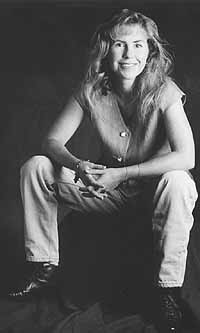 Straight, who will be at the Sun Valley Center for the
Arts Thursday evening for a 7 o’clock reading and reception, lives three
blocks from the Riverside hospital in which she was born. She is white,
the single mother of three and a professor of creative writing at the
University of California at Riverside.
Straight, who will be at the Sun Valley Center for the
Arts Thursday evening for a 7 o’clock reading and reception, lives three
blocks from the Riverside hospital in which she was born. She is white,
the single mother of three and a professor of creative writing at the
University of California at Riverside.
And none of that information gives you much insight into
her fiction. For Straight has written novels about a black firefighter
struggling with the responsibilities of fatherhood while his friends fall
prey to drugs and guns; a large black woman in swampy South Carolina; and,
most recently, a Mexican woman who meets up with and has children with a
methamphetamine freak.
All of this perhaps speaks to the point that the depth and
truth of fiction is limited only by scope of the author’s sensibilities,
which in Straight’s case are considerable.
Straight grew up in Riverside, then went to U.S.C. and, as
she said, "went home every weekend." At the age of 24 she
received a Masters of Fine Arts degree in creative writing from the
University of Massachusetts at Amherst. With the first snows at Amherst,
she found herself turning the heat of her apartment up to 80 degrees and
writing about tumbleweed and crows. "I knew then I wanted to write
about home."
Though she was lonely and living in a foreign geography,
Straight found the experience valuable. "I had time to work and
figure out what I [wanted] to write about. Sometimes you have to be lonely
so you can feel yourself." After graduation Straight went back to her
hometown.
"I tell my students that the hardest time you will
have is after you graduate. Right about then my friends started dying and
going to jail…I was struggling." She worked for the Job Corps,
taught and counseled gang members. She was sending her stories to the New
Yorker with some positive feedback. "They liked them, but they
said my world was just a little too grim for them. Well… yeah, it was
for me, too."
After a while, she stopped submitting stories for
publication. Then a professor from graduate school, Jay Newborn, called
her up and took her to task for not sending her stories out. Slowly,
Straight began to get stories published in literary magazines. She
subsequently won the Milkweed National Fiction Prize, which provided her
the opportunity to publish a collection of short stories entitled, Aquaboogie.
Publishing her second book was quite a bit easier. It was
a novel, I Been In Sorrow’s Kitchen And I Licked Out All The Pots,
and was bid upon at auction by five publishers.
Even with that experience, though, Straight has a fairly
sober attitude about her profession. "Nobody is going to wake up and
say, ‘write me a story today.’ "
Nonetheless, Straight does get up every day and write. She
wrote and published her second novel, Blacker Than a Thousand Midnights,
in 1994. And her third novel, Highwire Moon is coming out in
August. This is all on top of teaching a full load of classes at U.S.C.
Riverside, volunteering in prisons and youth workshops and raising three
children, aged 11, 9 and 5.
"I used to like to get a first draft for a new novel
done before I went out on book tour with the previous one, but with the
third child that sort of went out the door," she said.
As far as writing goes, having children has made Straight
"more disciplined. Once you have kids, you can’t drink coffee and
wait for the muse to strike. When the kids go to bed, you’ve got to get
going."
Straight, who just turned 40, has been teaching for 13
years. "I really like my students. I like to see what they are
writing about, what they are saying." And she doesn’t ever bring
her own writing into the workshops, except peripherally.
She relayed a story she told her students a while back. It
had to do with writing her last novel. "I thought all along I knew
who the killer was," she said, as if there were other forces at work
she didn’t entirely control. "I told my students that there has to
be a mystery and a passion there when you write." The implication was
obvious: if it isn’t there when you write, it certainly won’t be there
when someone finally reads it.
Straight’s reading, part of the Sun Valley Center’s
program West Word: Fiction from the New West, is free and open to the
public.