Wolf conference seeks solutions
Wolf shot near Mackay kill site
By GREG STAHL
Express Staff Writer
Since gray wolves were reintroduced to Idaho, their
populations have grown considerably. And with that increase in numbers,
the associated social conflicts in wolf country also have grown,
particularly among ranchers and hunters.
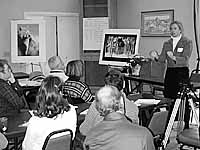 Deb Cooper, SNRA area ranger, speaks at
a wolf conference in Ketchum on Tuesday. About 40 people representing
ranchers, hunters, activists and land managers attended the all-day
meeting. Express photo by Greg Stahl
Deb Cooper, SNRA area ranger, speaks at
a wolf conference in Ketchum on Tuesday. About 40 people representing
ranchers, hunters, activists and land managers attended the all-day
meeting. Express photo by Greg Stahl
In a full-day meeting Tuesday in Ketchum, public lands
managers, ranchers, hunters and environmental activists gathered to
discuss wolf recovery efforts and the associated social conflicts, and to
discuss the road wolf recovery has yet to travel.
About 40 people attended the event at the Clarion Inn,
sponsored by the Boulder White Cloud Council, a Ketchum-based conservation
group.
Nez Perce wolf recovery leader Curt Mack said during a
break at the meeting that the gathering was timely. There was a lot of
concern about the program last summer, and the conference Tuesday was an
opportunity for various groups interested to try reaching "common
ground" before this summer’s grazing season begins.
"It’s an opportunity to understand each other’s
perspectives, to look for solutions," he said.
Lynne Stone, Boulder White Cloud Council executive
director, said the morning was used to examine the program’s past. The
afternoon would be used to look for cooperative solutions to the growing
number of wolf-related conflicts.
In 1995 and 1996, wolves were reintroduced to Idaho and
Wyoming under the federal Endangered Species Act (ESA).
In Idaho, 35 wolves were released. Thirty-one were placed
along the Middle Fork of the Salmon River, which flows north through the
heart of the Frank Church-River of No Return Wilderness Area. Four were
released near the northern fringe of the wilderness area along the Salmon
River at Corn Creek.
There are now estimated to be 191 wolves in Idaho, and
their range spans large portions of central Idaho.
For the past two years, wolves have increasingly been
clashing with Idaho ranchers, and several have been killed in "lethal
control" actions by the U.S. Department of Agriculture’s Wildlife
Services.
Last spring, conservationists protested the shooting of
members of the White Cloud Pack, which resulted in the pack’s being
disbanded.
During the summer, the Stanley Pack trod increasingly
thinner ice as it preyed on sheep in the Sawtooth Valley. After the U.S.
Fish and Wildlife Service gave the order to kill members of the pack last
fall, two members were relocated and one killed by lethal injection before
the grazing season ended. One of the relocated wolves was the pack’s
alpha male.
Last week, yet another wolf was shot and killed by
Wildlife Services near Mackay. The wolf, B-23, was previously the Stanley
Pack’s alpha female.
She was shot for preying on a cow calf and was known to
have previously preyed on livestock near Clayton and Stanley, according to
the U.S. Fish and Wildlife Service.
"Removal of B-23 is a good example of successful wolf
control," said Carter Niemeyer, Idaho wolf recovery coordinator for
Fish and Wildlife. "This wolf acted alone, was identified through
radio-collaring, was not a candidate for relocation, and was selectively
removed from the population in a humane manner."