Making it in the valley
Hispanics catch entreprenuerial fever
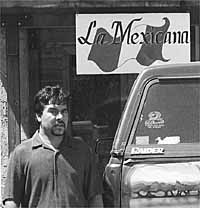
Today, Francisco Herrera’s store in Hailey has become a sort of
Hispanic community center where social and sporting events are organized and announced and
where, it seems, people come not only to buy things, but also to make contact with their
culture.
By TRAVIS PURSER
Express Staff Writer
 When Francisco Herrera moved to the Wood River Valley
eight years ago as a migrant farm worker who called Michuacan, Mexico home, he had almost
nothing—no wife, no money, no car, no job, no place to live.
When Francisco Herrera moved to the Wood River Valley
eight years ago as a migrant farm worker who called Michuacan, Mexico home, he had almost
nothing—no wife, no money, no car, no job, no place to live.
Now, the 32-year-old Herrera owns a prosperous store in Hailey that
supports a thriving family, a Woodside home, a house in Mexico and several new tricked-out
automobiles. What’s more, he has immediate plans to build a second house in Hailey
and to build a new, larger space for his business that supports it all.
"Myself," he says, "I never dreamed to do this well."
Herrera’s story starts out like that of many poor, young men who
migrate from Mexico to the United States. As a teenager, he wandered from one U.S.
agricultural region to the next, following the seasonal wage.
Adhering to Mexican custom, which obligates unmarried sons to help support
their families, he sent most of his earnings back home.
Meanwhile, typical of his ilk, he was torn between a deep-seated love of
home with its family-centered Mexican tradition and what America has to
offer—material well-being. And, like most, he says he was a "good worker with a
clean record." But, perhaps what sets Herrera apart, he says, is luck—and maybe
a girl.
Talking about the elopement with his wife Manuela Herrera, makes the
already voluble shop-keeper even more animated. At his store on the north side of Hailey,
La Mexicana—a sort of Mexican general store that, among other things, does big
business wiring money—Herrera spends long hours behind the counter.
Nearly all of his customers are Mexican, and he easily converses with them
in Spanish while speaking English with the few gringos who wander in.
In March of 1992, the then-25-year-old Herrera traveled to Hailey for the
first time, he says, to steal his future wife away from her family and to take her to live
with him in Immokalee, Fla., where he had work. Herrera said he and his wife had been
childhood sweethearts in Michuacan. But the couple had to elope, he said gamely, because
in 1992 "I had two or three girlfriends; that’s why [her parents] weren’t
sure about the marriage."
Manuela Herrera, at the time, cooked at the Hearthstone restaurant, which
is now a sporting goods store in Hailey, but "we ran away from that place," he
said, laughing. "If her parents had found out I was in town, they would have locked
her up."
Herrera made an important discovery in the Wood River Valley. Wages here
were double the $4.25 an hour he was making working on southeastern U.S. tobacco
plantations. And that, he said, he learned from a man who earned almost $9 an hour here
and "didn’t speak English." A high paycheck, together with the Mexican
tradition of extending seemingly unconditional support to family members, led Herrera and
his new wife to move permanently to Hailey, and into Manuela’s parents’ house.
"It works that way," Herrera said. "It’s like a little
help. We cannot tell relatives, ‘You cannot stay here.’ Feelings don’t
allow you."
A year later, the couple moved into the Woodhaven apartments in
Hailey’s Woodside subdivision, and Herera became groundskeeper for the units at $7 an
hour. The bright and obviously hardworking Herrera was soon promoted manager of the
complex, which nearly doubled his wage to $13 an hour. The couple’s first child,
Joseline, now 7 years old, was born, then Guy, now age 6.
With the extra responsibility of parenthood, the father made his first
entrepreneurial attempt in 1996—a store in Bellevue called Family Boutique. "But
people called it La Mexicana," he said, because they
couldn’t pronounce "boutique."
Looking back, the now-successful businessman says that the store was
merely a trial run, an aborted, nascent effort to sell artificial flowers and "nice
clothing for ladies" to "both people—American and Mexican."
But Herrera found he had stumbled onto something bigger. The growing
Hispanic community in the Wood River Valley demanded a whole slew of ethnic goods not
available here. So, Herrera imported the items from Los Angeles and Michuacan, driving his
van south himself to do so. With nearly 700 full-time Hispanics now residing in the
valley, according to the U.S. Census Bureau, and probably significantly more than that, by
many estimates, migrating in seasonally, Herrera’s store became a smash success.
In 1998, he moved the store, now officially dubbed La Mexicana, to Hailey
and added new, profitable services like electronic money transfers and phone card sales.
Today, the store has become a sort of Hispanic community center where
social and sporting events are organized and announced and where, it seems, people come
not only to buy things, but also to make contact with their culture.
Herrera says he takes very little credit for all of this. "I never
dreamed to have a store in America," he said.
#
The small groups of men who show up throughout the day on Fridays, arrive,
for the most part, in work clothes and muddy work boots. Almost without exception, they
come to cash paychecks and send most of the money back home to Mexico. With what’s
left over, they sometimes buy a phone card for long-distance calls or any of the myriad
goods Herrera sells.
The store is a veritable grab bag. Spanish-language CDs and movie videos
take up most of one wall. Clothes of every description hang near the ceiling. Tucked
discretely into a corner, a wire frame displays a seductive women’s bustier. Below
that: chromed exhaust tips for your car. Bras, hurachas (leather sandals), soda-pop, dried
chilies, Mexican toiletries, artificial flower arrangements and jewelry.
The store, it seems, strives to supply anything someone homesick for
Mexico would want.
Friday morning three weeks ago, Oswaldo Medina, 23, arrived with several
other Hispanic men. The Mountain Express had interviewed Medina earlier that week
in Bellevue, where he lives with five people in a 400-square-foot, one-bedroom apartment.
Medina had said that he works seven days a week, holding down three jobs in the valley,
that his share of the rent is less than $100 per month, that he has been here less than a
year and plans to return to his home, Mexico City, in the not-too-distant future.
After a brief transaction conducted in Spanish, Herrera said he had cashed
Medina’s paycheck and sent the entire amount to Medina’s family in Mexico. Then
Herrera had loaned his financially plucked customer a phone card until next payday.
"That is the key to my business," Herrera said. "Make them
comfortable, make them favors—little things which mean nothing to me, but mean a lot
to them."
No doubt Herrera can afford such favors because wiring money is a
lucrative business. The fee he charges for each transaction increases with the amount of
money sent; but, for example, a $1,000 transfer costs $35 and takes only a minute to
complete.
Last month, Herrera said he sent $380,000 to Mexico. That amount changes
depending on the season—March being the "time when everybody comes to
Idaho." But "everyday, we have more Hispanic people. It’s a lot of
responsibility to deposit $20,000 in one day," he said, seeming as surprised as
anybody at the numbers.
Herrera’s competition in the wire transfer business is minimal.
Generally, banks don’t provide the service, and even if they did, Herrera said,
Hispanics prefer to patronize Hispanic-run businesses. Western Union charges more than
Herrera does. For example, a $1,000 transfer costs $55—$20 higher than Herrera’s
fees. And a store in Bellevue called California Jewelry, which is similar to
Herrera’s store, but smaller, charges a flat rate of $15. Marianne Lopez, the
store’s proprietor, did not divulge the amount she wires each month. She claimed,
however, that she makes no money from the service.
Combine Herrera’s impressive wire-transfer numbers with his claim
that he makes even more money off retail sales and telephone card sales, and it’s
easy to see why he’s doing so well. Often, his late-model 4X4 Chevy truck is parked
outside the store. It’s painted metallic blue and gleams with shining chrome.
An airbrushed mural on the tailgate depicts the truck parked on a beach
with two barely clothed female bathers near the shore. Painted across the top of the
mural: "Family Herrera Forever." Other vehicles include a Dodge van and another
pickup painted candy-apple red.
Last year, Herrera bought an 11,000-square-foot lot near his current home
in Woodside. He only has three more $2,400 payments to make on the lot, he said, before
he’s owns it outright. Herrera said he plans to build a second house on the lot to
accommodate his still-expanding family that now includes his two youngest
children—4-year-old Kimberly and 1-year-old Dennise. His current house, he plans to
keep and rent.
Then there is his immediate desire to find and purchase a piece of land
off River Street so he can build a larger store and not have to pay rent on a retail
space.
And, with obvious pride, he shows photos of his recently renovated and
expanded house in Michuacan. The opulent, two-story, pink and white structure sits amid
smaller, bleaker houses in a town that he said, "is not that beautiful, but it’s
quiet. I say it’s great." Interior photos show two living rooms, a full bar
constructed of a highly polished, rare and expensive Mexican hardwood and youngsters
Joseline and Guy frolicking in a bathroom covered from floor to ceiling with white marble.
Nevertheless, Herrera said he never thinks about moving back to Mexico
permanently, because, he said, "I want my kids to go to school here."
#
If there is anything that Herrera seems to regret in his recent good
fortune it’s that he is now almost irrevocably torn between a prosperous American
world—that he feels doesn’t give enough recognition to contributions made by
Hispanics—and the world from which he sprang—Mexico, with, as he describes the
culture, its familial "love and respect."
Speaking generally about the Wood River Valley, he said, "Most of the
people here are rich. It sounds wrong, but they want us just for work."
Herrera admitted that the newer Hispanic population keeps the two cultures
"separated" as much as the longer-established American population does. Most
Hispanics, he said, don’t speak English, so they feel most comfortable associating
with other Hispanics.
And, "We still keep our own traditions, and that’s strange for
you guys. It’s nothing bad; it’s just a style of life. Me, I don’t feel
separated, because I have to deal with both. But sometimes, I feel people think we are not
smart enough. They think we take your jobs over. They think we’re wild."
For example, Herrera pointed to three soccer players who had come into the
store—one, sporting dark, wrap-around sunglasses, nicknamed "Hombre
Mosca"—who continually shuffle their organized games from one field to another
because, it seems, nobody welcomes their raucous contests. The spectators leave beer cans
on the ground, Herrera said, but the players pick up the cans after the games; "My
feeling is people don’t want them to get together."
The separated cultures affects Hispanics in other ways, too.
No doubt, for the marginalized Hispanic population it is difficult to do
many things that the longer-established American population takes for granted—like
banking, negotiating a lease on a retail sales space or figuring out how to pay taxes.
Running his store, Herrera said, "took me a long time to learn, because nobody teach
me how a store works. Now, I know not everything, but a little bit more. Over the years,
you have to find out where you make a little bit more money."
Still, Herrera, at least, is uncomfortable with the idea of total
integration—especially when it concerns his children. "I won’t let that
happen," he said. "That’s why I take them to Mexico to learn. We have this
love and respect, and that’s a good thing to have that."
Mostly, Herrera referred to love of the family and respect for the elders.
In 1994, Herrera’s parents, four of his five sisters and his three brothers moved to
Bellevue and have now bought a house there. Like most Hispanic families, Herrera said, his
relatives all help each other, and he hopes that tradition continues in the face of
American culture’s glorification of individuality.
Even so, he’s resigned to change. In local schools, his children
learn both cultures, he said. "It’s hard, but it becomes normal for them.
Eventually, [Mexican culture] is going to pass out, but that’s life. It depends on
us. Some people feel that’s just the way it is.
"For now, I teach them where they come from, to be proud, and not to
be afraid to say, ‘I’m a Mexican.’"