The Cairncross collection
Ketchum collectors share collection of Northwest painters
By HANS IBOLD
Express Staff Writer
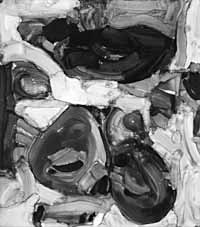 Alden Mason’s evocative "Garden Cradle" is included in the
Cairncross collection. Courtesy Sun Valley Center for the Arts
Alden Mason’s evocative "Garden Cradle" is included in the
Cairncross collection. Courtesy Sun Valley Center for the Arts
Ray Cairncross shatters the perception, shared by many, that art
collectors are snobby and condescending. Watching and listening to him gesture and talk
art in the gallery-like entry to his home north of Ketchum, it becomes clear that he loves
to share his passion for art with newcomers.
Owner of perhaps the widest collection of contemporary art from the
Pacific Northwest, Cairncross is the sort of collector who appreciates nothing more than
sharing the joys of collecting to newcomers.
"You have to get over the notion that a piece of art means one
specific thing," he said, gazing at one of his enormous paintings by the abstract
Seattle painter Charles Ivy.
He and wife Wendy, who have lived here with their two children since they
moved from Seattle in 1996, have been collecting art for almost three decades.
"It’s perfectly legitimate to look at a painting like Ivy’s
and try to figure out what it means to you," he said. "There’s no correct
way to view it."
It’s hard to believe that Cairncross, who is obviously still riveted
by Ivy and by other works in the house, would be willing to loan them out. Some 30
paintings in the couple’s collection will be loaned to the Sun Valley Center for the
Arts later this week for an exhibit, entitled "Northwest Masters: Paintings from the
Cairncross Collection." It opens at the Center Monday and runs through mid-March.
A slide lecture on artists in the exhibit will be offered by art historian
Martha Kingsbury on Feb. 17 at 7 p.m. at the Center. Also, a walk-through with the
collectors—including Glenn Janss, who donated several pieces by the Northwest painter
Morris Graves—will be offered Feb. 19 at 7 p.m.
In her introduction to the exhibit, the Center’s artistic director
Kristin Poole writes that "the [Cairncross] collection is a testament to two
people’s respect for different kinds of art—that which is primarily appreciated
intellectually and technically and that which speaks to the soul and the human condition.
It is a collection which attests to the range of visions and influences that have shaped
the rich and diverse art community found in the Northwest today."
It is also a testament to the Cairncross approach to art: you learn about
it by saturating yourself in it. Neither Ray nor Wendy have any formal art training or
grew up in households where anyone collected art. Yet, they amassed a museum-quality
collection.
"You learn about art by looking at art," Cairncross said.
That’s just what Cairncross did when he lived in Seattle in the
1960s. After graduating from the University of Washington’s law school and while
working at a Seattle law firm, Cairncross said he would take lunch breaks at local
galleries.
On those gallery stops, Cairncross developed an interest in Seattle’s
Abstract Expressionists who came to be known as the Northwest School—Mark Tobey, Guy
Anderson, Kenneth Callahan and Morris Graves.
"I went about it quietly," he said. "I would walk through
the galleries, focus on an artist and file away my thoughts and reactions. I responded to
the spiritual content of their work. I’d try to figure them out, see how their
palette changed and see what was consistent in their work."
What was consistent in the work of the Northwest School, he said, was
"a kind of meditation on the human condition" and colors that pervade the rainy
Northwestern landscape—browns, grays, greens.
Those qualities separated the Northwest School from the Abstract
Expressionists of New York City, where the style took root in the 1940s. Abstract
Expressionism is widely considered to be the most original American art style ever
created. Jackson Pollack—famous for his so-called drip-and-slash paintings—is
probably the best known of the New York Abstract Expressionists.
The painters in the Northwest School were influenced by the freedom and
spontaneity endorsed by Pollack and others in New York. They differed, however, from their
East coast counterparts by embracing the natural landscape and Eastern philosophy.
"[They are] deeply interested in the spiritual nature of art,"
writes Poole. "Theirs was an introspective abstraction that was rooted in nature and
aspired to illustrate the cosmos…These artists shared a high moral ground—a
sense that the arts mattered and could and should assume an important role in shaping
society."
While paintings from the Northwest School cover most of the walls in the
Cairncross home—even the bathrooms—Ray is quick to point out his less
conspicuous collection of tribal art from Tanzania—spears, devil carvings, walking
sticks and bowls. The tribal pieces, which he collected while serving in the Peace Corps
in the 1960s, opened his eyes to the world of fine art. "That was the beginning of my
interest in fine art and collecting," he said.
It seems fitting that he picked up the collecting bug while working in a
Tanzanian village, where carvers were working so beautifully in such isolation. The same
could be said of the Seattle painters Cairncross stumbled on during his lunch breaks in
the 1960s. Except, now the painters have a school named for them and a Ketchum collector
who has given them a voice.